Tutankhamun's Golden Mask: History, Symbols and Where to See It
Explore Tutankhamun's golden mask, its history and symbolism, and plan a Grand Egyptian Museum visit with this CasaViajes guide.
The essentials at a glance
- The current GEM catalogue places the mask in its Tutankhamun Galleries.
- The mask, coffins and sarcophagus are different objects.
- The tomb's discovery in 1922 is distinct from the mask's revelation in 1925.
- Tomb KV62 is in Luxor; seeing the mask in Giza is a separate visit.
- Reconfirm access and photography rules before travelling.
Some faces are familiar long before we know their stories. Tutankhamun's golden mask is one of them: luminous gold, blue lines and a gaze that encourages a closer look. Yet treating it only as a famous photograph means missing much of what makes the object worth understanding.
This CasaViajes guide approaches the mask as both an artwork and a funerary object. It connects the discovery with its context and helps you plan a visit without confusing museums, tombs or tickets. There is no need to memorise a catalogue: knowing what to notice and which questions to ask is a useful beginning.
Where is Tutankhamun's mask?
The Grand Egyptian Museum's official catalogue places the mask in its Tutankhamun Galleries, under collection number 8. That is the current reference for planning a visit in Giza, rather than older pages that still associate the object with the Egyptian Museum in Tahrir Square.
Editorial verification: 6 November 2026. Reconfirm access through official channels before booking. An itinerary should not turn a museum visit into an unconditional promise that a particular object will always be available to view.
Who was Tutankhamun?
Tutankhamun was an Eighteenth Dynasty pharaoh of the New Kingdom. The Ministry of Tourism and Antiquities' account of his tomb explains that he became king very young and ruled for about nine years.
For a visitor, the most rewarding question is not necessarily a date. How does a real person's life become an image intended to endure? Bringing that question into the gallery changes the pace of a visit. Instead of another quick photograph, the mask becomes an opportunity to consider the relationship between a ruler, an artwork and the people who made it.
A funerary mask, not a sarcophagus
Objects from the burial are often mixed together in photographs and popular descriptions. A mask is not an entire coffin, and it is not the outer structure of the burial.
The Metropolitan Museum's explanation of the discovery describes the mummy with its mask inside three coffins, themselves placed in a sarcophagus. Understanding those layers helps you identify the object in front of you and follow a guide's explanation without confusing different sizes, materials or purposes.
Gold, colour and a carefully constructed gaze
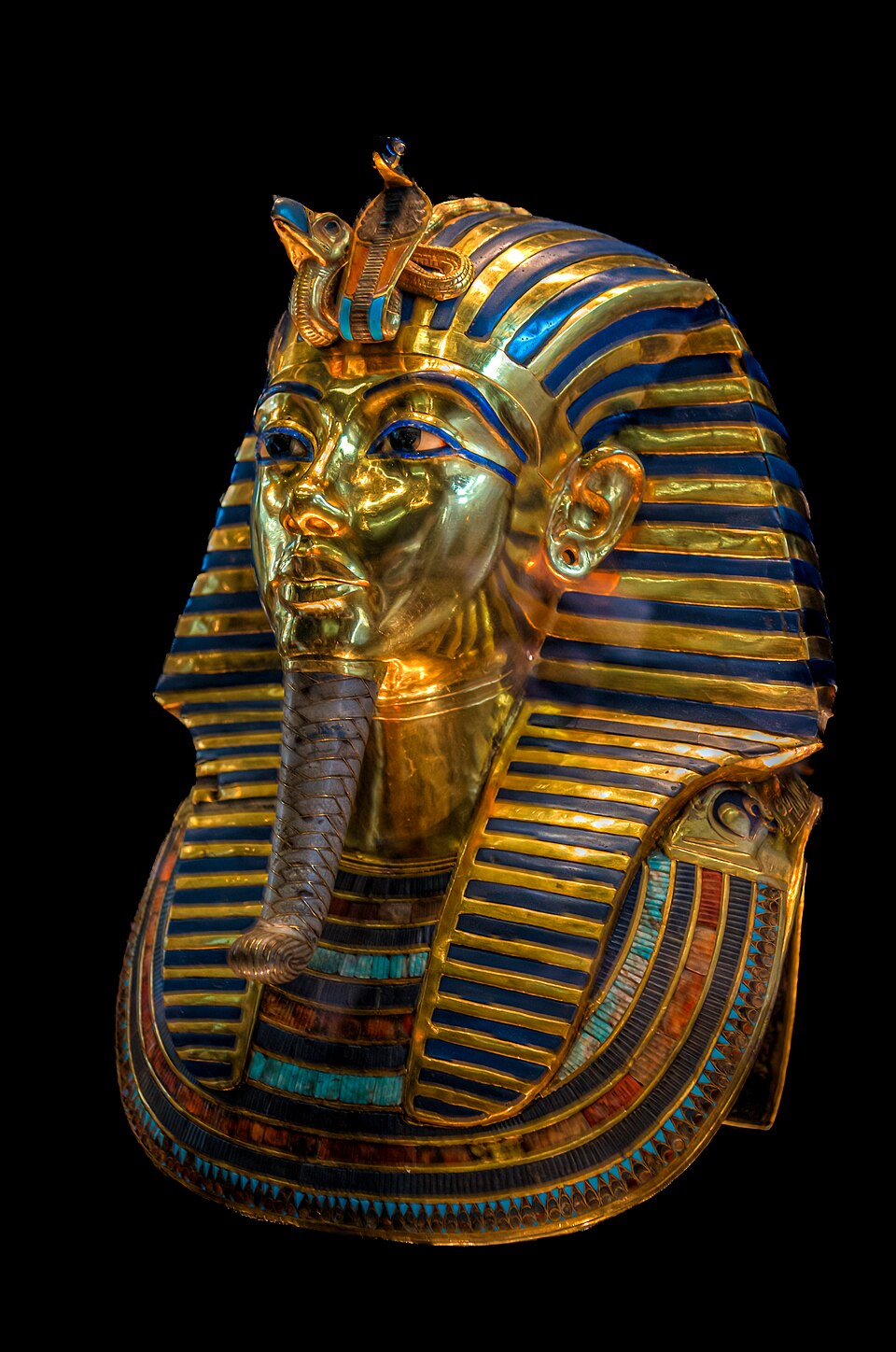
The Global Egyptian Museum's object record gives a height of 54 centimetres and a width of 39.3. It describes worked and joined gold sheets, eyes made with obsidian and quartz, and lapis lazuli inlays in the eyebrows and eyelids.
Rather than trying to name every material from a distance, look at the contrasts: reflective and darker surfaces, lines framing the eyes and the transition between the face and headdress. Choose one detail, remember it and then look for an explanation on the label. This makes close observation possible without occupying the best viewing position for too long.
The cobra, the vulture and royal symbolism
A cobra and a vulture appear on the forehead as emblems of royalty and protection. The same museum record helps identify them as more than decorative additions.
The mask should also be distinguished from the king's diadem: the GEM catalogues the diadem as a separate object, found beneath the mask and likewise associated with symbols of sovereignty. For your visit, that distinction suggests a useful question: are you looking at part of the headdress or an independent piece of jewellery?
A face intended for eternity
The GEM interprets the mask in relation to Osiris and the sun god Re. It is not simply an everyday likeness, but an ideal image of the king connected with his existence after death. An inscription on the back adds protection by associating parts of the body with different deities.
You do not need to read hieroglyphs to appreciate this dimension. Begin with a question: what was the object meant to achieve? Beauty and function then stop being competing explanations and start making sense together.
1922 and 1925 are different moments
The discovery of the tomb in 1922 and the appearance of the mask during work on the burial were not a single event. The fourth-season archaeological journal preserved at Oxford records that the gold coffin's lid was lifted on 28 October 1925, revealing the mummy with its mask.
The Griffith Institute archive identifies the object as 256.a. This is a reference for historical documentation, not a museum admission number. Keeping these dates and numbering systems separate avoids a common confusion and makes it easier to follow the excavation story.
An archive photograph for a closer look

Archive photograph: Tarek Heikal (Tarekheikal), 23 December 2015. Original file and attribution on Wikimedia Commons, licensed under CC BY-SA 4.0. Existing reduced web version provided by Wikimedia, with no additional retouching. The image and any derived framing retain that licence. This is an archive image, not a photograph of the current GEM display. No photographer endorsement of CasaViajes is implied.
Planning your GEM visit
The GEM's official ticketing website includes the Tutankhamun Galleries in the visit and publishes current hours and conditions. Check there before booking; this guide does not set ticket prices or guarantee queue times.
As an editorial planning suggestion, make a short list before leaving: the mask, one related object and one question you would like answered. Leave space between activities and ask for a written itinerary identifying transport, guiding and inclusions. Families can agree on pauses; visitors needing mobility support should enquire about their particular requirements before committing. These are planning decisions, not services that should be assumed to come automatically with admission.
Photography and a considerate visit
Official rules include photography restrictions in designated parts of the Tutankhamun Galleries and prohibit flash. Follow staff instructions and the signs in each gallery: permission to photograph one area should not be treated as permission everywhere.
If photography is not allowed, change the aim of the stop. Find one detail that surprises you and make a note afterwards. A meaningful memory of a museum does not have to depend entirely on a camera.
The mask in Giza and the tomb in Luxor
Tomb KV62 is in the Valley of the Kings at Luxor. Visiting it and seeing the mask at the GEM are separate experiences in different places. Museum admission is not the same thing as a visit to the tomb.
If you want to connect the two, think in stages. In Giza, concentrate on the objects; in Luxor, consider the setting of the burial. Ask for each stage to have its own clear conditions and inclusions, and avoid compressing them into a single vague excursion promise.
Questions to ask before booking
Is the mask different from the coffins?
Yes. Ask your guide to explain the layers of the burial. Recognising those relationships is more useful than remembering a sequence of photographs without context.
Is there a fixed amount of time to spend with it?
We do not suggest an obligatory viewing time. Build some flexibility into your route and adapt to visitor numbers, your interests and gallery instructions.
What should I confirm with a travel company?
The date, museum, access conditions, transport, guiding language and written inclusions. If a particular object matters especially to you, mention it when planning and reconfirm before travelling.
Plan your route with CasaViajes
To place this visit in a wider itinerary, read our Grand Egyptian Museum visitor guide. Then tell us what you would like to discover in Egypt and request a CasaViajes proposal shaped around your priorities.
A rewarding visit is not about collecting the most stops. It is about leaving with a story you understand more clearly than when you arrived.
Sources & references
- Grand Egyptian Museum: current mask catalogue entry, GEM 8
- Grand Egyptian Museum: official tickets and visitor conditions
- Global Egyptian Museum: materials and dimensions (historical location in its record)
- Griffith Institute, University of Oxford: object record 256.a
- Griffith Institute, University of Oxford: fourth-season journal, 1925–1926
- Ministry of Tourism and Antiquities: Tutankhamun's tomb, KV62
- The Metropolitan Museum of Art: Discovering Tutankhamun and the burial layers
- Grand Egyptian Museum: the diadem as a separate object