Kom el Shoqafa Catacombs: An Alexandria Visitor Guide
Explore the Catacombs of Kom el Shoqafa in Alexandria: their history, reliefs and practical advice for planning your visit with CasaViajes.
The essentials at a glance
- Kom el Shoqafa is an underground Roman-period necropolis in Alexandria.
- Its decoration brings Egyptian and Greco-Roman references together.
- Kom el Dikka and the Serapeum of Saqqara are separate visits.
- The UNESCO reference is a Tentative List submission, not World Heritage inscription.
- Confirm admissions, stair access and available time; the suggested 45–75 minutes are a planning estimate.
The Catacombs of Kom el Shoqafa offer a different view of Alexandria from the familiar harbour postcards. The visit invites you to slow down, enter an underground burial complex and consider how its architecture and decoration bring different traditions together. It is a place to look closely, rather than simply collect another photograph.
This CasaViajes guide combines historical context, details to notice and practical planning advice. Suggested timings and nearby visits are ideas to discuss: your confirmed programme should identify the admissions and services it includes.
Kom el Shoqafa at a glance
- Location: Alexandria, on Egypt's Mediterranean coast.
- Type of monument: an underground necropolis of the Roman period.
- Main interest: funerary architecture combining Egyptian and Greco-Roman references.
- Planning points: stairs, your group's pace and the admissions for each stop.
What are the Catacombs of Kom el Shoqafa?
Egypt's Ministry of Tourism and Antiquities describes a Roman-period necropolis with burial spaces, a chapel and a funerary banqueting area. Its paintings and reliefs combine Egyptian and Greek traditions.
That description gives you a useful approach: consider what the rooms were for as well as how they were decorated. Asking about the function of a space can make the visit more meaningful than identifying individual figures without their context.
When were the catacombs used?
The UNESCO Tentative List documentation for Alexandria places the necropolis in the late first or early second century AD, with use continuing into the fourth century. Its setting is therefore Roman-period Egypt.
You do not need to memorise a complete timeline to appreciate the monument. Establishing that context helps avoid treating every feature as if it belonged to the same period as the Giza pyramids or the tombs of the Valley of the Kings.
What to look for during the visit
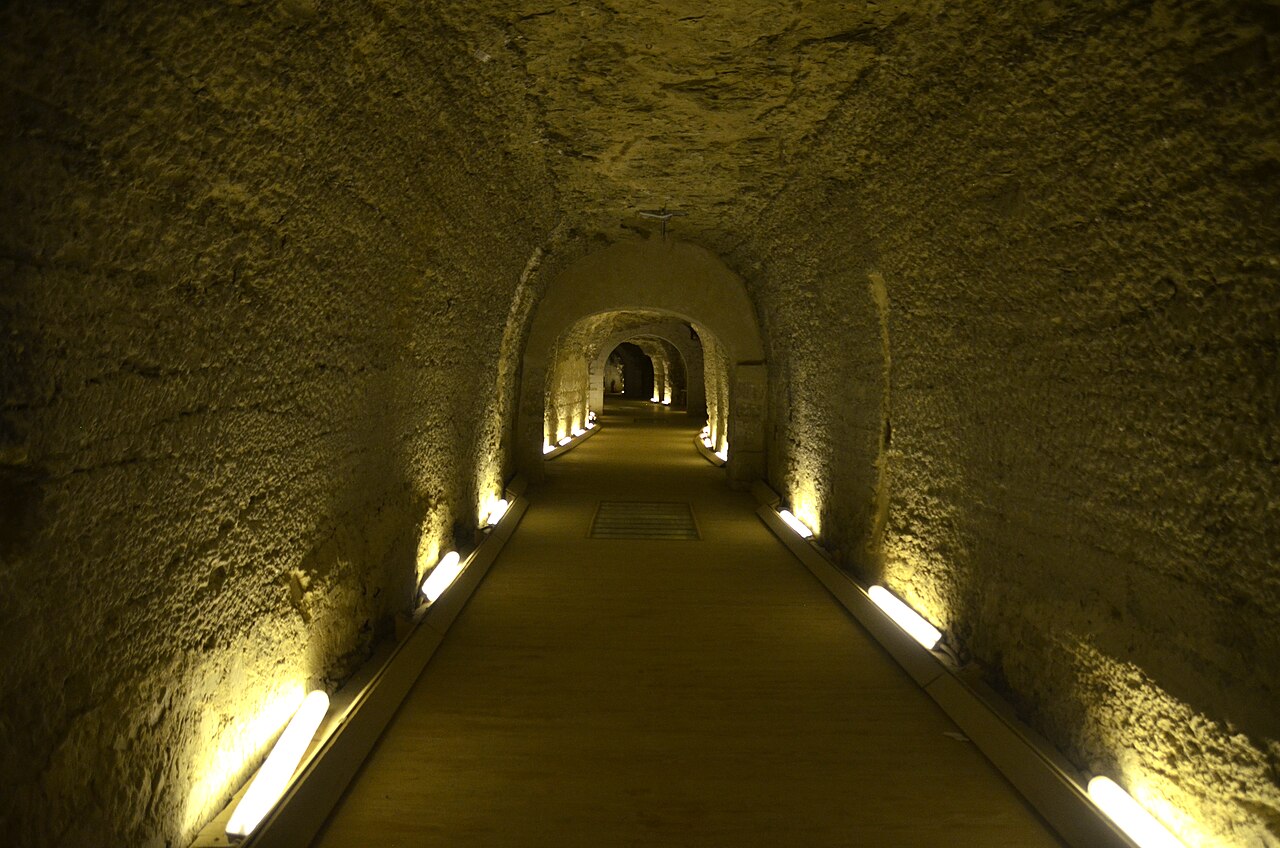
The descent and connecting spaces
Give some attention to the route itself, rather than focusing only on the most photographed chamber. Notice how your sense of the space changes as you move, and ask how the rooms relate to one another. Allow time to stop without blocking the rest of the group.
The permitted visitor route can change. An archive photograph cannot confirm which sections will be accessible on your travel date, so reconfirm the current arrangements.
The carved façade and reliefs
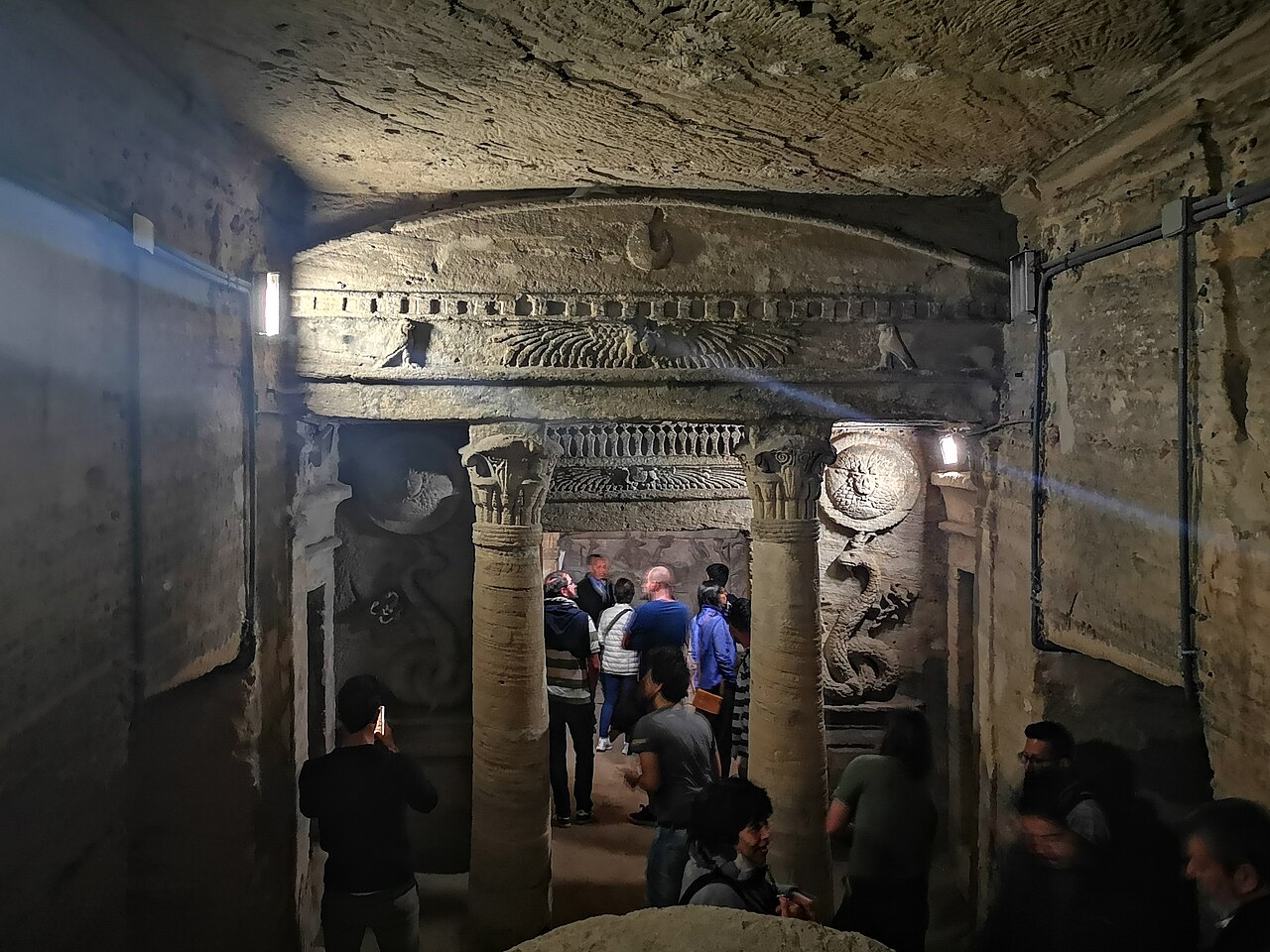
The photograph in this guide, taken in 2020, shows a carved interior façade with columns and reliefs. Use it to prepare a few questions: which elements serve an architectural purpose, which belong to the decoration, and how does the doorway relate to the figures around it?
A measured explanation helps you appreciate the details without turning every symbol into an improvised interpretation. Ask your guide to distinguish documented evidence from a proposed explanation.
The funerary banqueting area
The banqueting space identified by the Ministry is a reminder that the monument also relates to ceremonies carried out by the living. Ask how it fitted into funerary practice. It is not a dining room for present-day visitors.
How much time should you allow?
As an itinerary suggestion, CasaViajes recommends considering around 45–75 minutes, in addition to transfers and entry arrangements. This is not an official visit duration or a guarantee: group size, stops, stairs and access conditions can all affect the time needed.
If you are visiting Alexandria from Cairo, allow room for the outward and return journeys too. Choosing a few priorities is usually more rewarding than filling the schedule with stops that leave little time to understand what you are seeing.
Tickets, stairs and preparation
Confirm what your booking covers
Before confirming the programme, ask whether the Kom el Shoqafa visit and its admission are included. Clarify whether the service covers a guide, transport and any other interiors. A list of place names does not always explain what happens at each stop.
Recheck prices, opening arrangements and visitor conditions close to your travel date. This guide does not set an admission price or promise entry to every room.
Plan a comfortable pace
Mention any difficulty using stairs or discomfort in enclosed spaces in advance. Ask about the current route and the possibilities for adapting the visit; do not assume a route without steps is available.
Wear comfortable footwear and follow staff instructions. With children, plan a pace that suits the group and avoid letting photography interrupt circulation. Check the rules before using flash or additional photographic equipment.
What can you combine it with in Alexandria?
Kom el Dikka: a different archaeological setting
Kom el Dikka preserves remains of a Roman and Byzantine quarter, including civic and residential spaces. It offers a change of context after the necropolis. It is a separate site from Kom el Shoqafa and needs its own place in the itinerary.
The Greco-Roman Museum
Alexandria's Greco-Roman Museum displays collections connected with Egypt's Greek and Roman periods. If you want to continue exploring the historical context through objects, ask about combining an archaeological site with a museum visit.
Qaitbay Fort and the waterfront
Qaitbay Fort offers another possible part of the day by the sea. Consider how much time you want for its interior, a walk and a break. These options and their admissions need to be agreed in your programme; they are not automatically included.
Frequently asked questions
Are Kom el Shoqafa and Kom el Dikka the same place?
No. Kom el Shoqafa is a necropolis; Kom el Dikka is a different archaeological complex. If you want to see both, ask for each to be identified clearly in the itinerary.
Is this the same place as the Serapeum of Saqqara?
No. The catacombs are in Alexandria. The Serapeum of Saqqara belongs to another area and funerary context. They are not alternative names for the same visit.
Is Kom el Shoqafa itself an inscribed UNESCO World Heritage property?
The reference used here is Alexandria's Tentative List submission. Inclusion on that list is different from inscription on the World Heritage List.
Can it be added to an Egypt programme?
You can request it before confirming your trip or ask for a change to an existing programme. The addition and any supplement should be confirmed in an updated proposal, subject to availability and timing.
Plan Alexandria with CasaViajes
Contact CasaViajes with your approximate dates, group size, departure point and the Alexandria sites that interest you. Mention any needs related to stairs so the route can be considered before you book.
Sources checked on 28 November 2026. Suggested timings are planning estimates; reconfirm prices, opening arrangements and access conditions before travel.
Archive photograph: Carole Raddato / Following Hadrian, 15 February 2020, via Wikimedia Commons. Licensed under CC BY-SA 2.0. Uses Wikimedia's reduced-size version without further changes; no endorsement of CasaViajes by the photographer is implied.